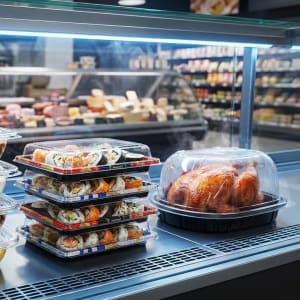
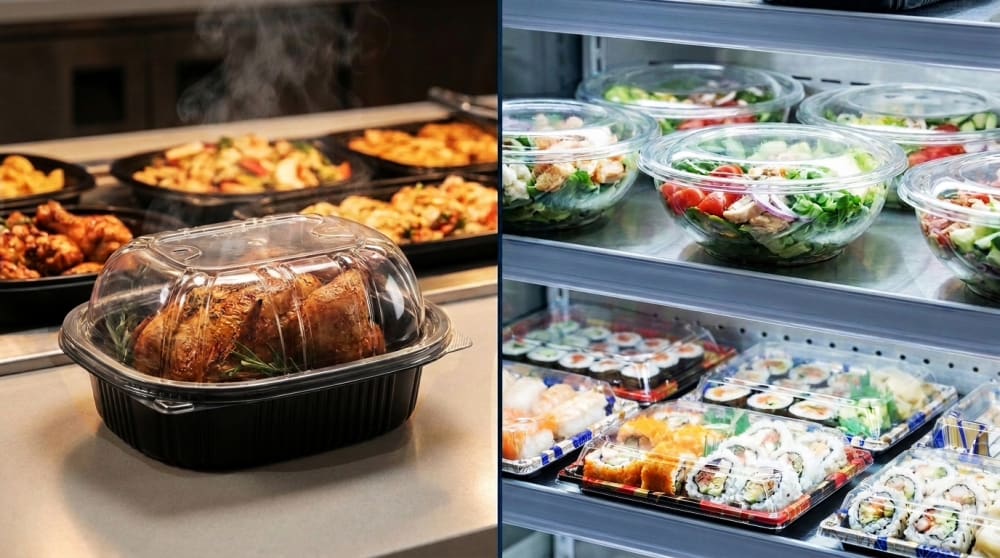
What is the difference between PET/rPET (#1) and PP (#5) thermoformed food containers?#
PET and PCR rPET (#1) are glass-clear polymers engineered for cold-chain and ambient food display (`-20°C to +60°C` / `-4°F to 140°F`), whereas Polypropylene (PP #5) is a high-heat polymer engineered for hot-fill, steam tables, heat lamps, and consumer microwave reheating (`-20°C to +120°C` / `-4°F to 248°F`).
When US supermarket deli directors, central commissaries, and meal-kit brands specify rigid packaging, matching the polymer to the thermal journey is the single most important engineering decision. Specifying standard PET for a hot-case rotisserie or microwavable entrée leads to warped bases and seal failure, while specifying standard unclarified PP for a cold fruit or sushi display sacrifices glass-like optical merchandising.
With 23 years of vertically integrated thermoforming experience, Raytek Packaging (Dongguan Raytek Blister Packaging Co., Ltd.) extrudes both food-grade PET/rPET and high-crystallinity PP sheets in-house, forming precision bases and lids inside an ISO Class 8 (Class-100,000) cleanroom.
How do temperature limits and optical clarity compare across Virgin PET, PCR rPET, and PP?#
Virgin PET and food-grade PCR rPET offer superior optical clarity and cold-impact strength down to `-20°C (-4°F)` but begin to soften above `60°C (140°F)`. Food-grade PP withstands continuous hot-fill and microwave reheating up to `120°C (248°F)` while maintaining chemical resistance to hot oils and sauces.
Side-by-Side Polymer Specification Table for US Food Buyers#
| Specification Metric | Virgin PET (#1) | Post-Consumer Recycled rPET (#1) | Food-Grade Polypropylene (PP #5) |
|---|---|---|---|
| Operating Temp Range (Metric) | -20°C to +60°C | -20°C to +60°C | -20°C to +120°C |
| Operating Temp Range (US Imperial) | -4°F to 140°F | -4°F to 140°F | -4°F to 248°F |
| Microwave & Hot-Case Safe? | No (Cold & ambient foods only) | No (Cold & ambient foods only) | Yes (Microwave, hot-fill & heat lamps) |
| Optical Clarity & Gloss | Crystal-clear (Glass-like 360° visibility) | High clarity (Up to 100% PCR content) | Contact-clear, natural translucent, or black/white |
| Anti-Fog Lid Compatibility | Yes (Double-sided FDA 21 CFR anti-fog) | Yes (Double-sided FDA 21 CFR anti-fog) | Yes (Often paired with vented anti-fog PET/PP lids) |
| US Curbside Recyclability | Widely recyclable (#1 APR preferred) | Widely recyclable (#1 APR preferred + EPR credit) | Widely accepted (#5 mono-material curbside) |
| Primary Supermarket Applications | Berry clamshells, sushi trays, cold salads, bakery | Sustainable produce, grab-and-go deli, sushi | Rotisserie chicken, microwave ready-meals, hot soups |
Can you combine a microwave-safe PP base with a clear anti-fog lid?#
Yes. For chilled prepared meals and supermarket hot-case items, Raytek Packaging engineers hybrid and matched container systems featuring a heat-resistant PP (#5) base (`-20°C to +120°C`) paired with a crystal-clear, vented anti-fog dome lid machined to +/-0.15 mm snap-fit tolerances.
In many US grocery delis and meal-kit programs, meals are packed cold, displayed in a 34°F–38°F refrigerated multideck case, and later reheated by the consumer in the microwave—or held warm under 150°F supermarket heat lamps. Our in-house CNC aluminum mold workshop engineers leak-resistant perimeter snap-fit rims and precision steam-release vents so lids stay fog-free on the shelf and prevent pressure pop-offs during warming.
4 Checks Before Finalizing Your Container Material Spec#
- 1. Peak Filling & Reheating Temperature: If the food is hot-filled above
140°F (60°C)or marketed as microwave-in-tray, specify food-grade PP (#5) for the base. - 2. Cold-Storage & Freezer Impact: For sub-zero blast freezing or cold-chain transit, specify cold-impact PET/rPET or impact-modified freeze-to-microwave PP.
- 3. Automated Line Denesting & Sealing: Both our PET/rPET and PP trays are formed with
+/-0.15 mmflange tolerances and precision denesting lugs for jam-free automated dispensing. - 4. Auditable FDA 21 CFR & PFAS-Free Compliance: All Raytek Packaging PET, PCR rPET, and PP sheets are 100% PFAS-free and US FDA 21 CFR food-contact compliant (21 CFR 177.1630 for PET; 21 CFR 177.1520 for PP), backed by BRCGS certification and third-party migration reports.
Frequently Asked Questions (FAQ)#
Why do standard PET containers warp in the microwave or dishwasher?#
Polyethylene Terephthalate (PET #1) has a glass transition temperature around 67°C–70°C (152°F–158°F). When exposed to boiling water, hot oil, or microwave heating, amorphous PET softens and shrinks. For any application exceeding 60°C (140°F), polypropylene (PP #5) is the correct engineering choice.
Does switching from Virgin PET to PCR rPET change the temperature rating?#
No. Food-grade Post-Consumer Recycled (PCR) rPET maintains the exact same thermal operating window (-20°C to +60°C / -4°F to 140°F), dimensional stiffness, and automated denesting performance as Virgin PET.
Can Raytek Packaging provide both PP and rPET samples for side-by-side line testing?#
Yes. Because we extrude PET, PCR rPET, and PP sheets in-house, we can dispatch stock validation kits within 24–48 hours or machine custom prototype molds in 7 to 14 days so your QA team can test both materials under real cold-chain and microwave conditions.